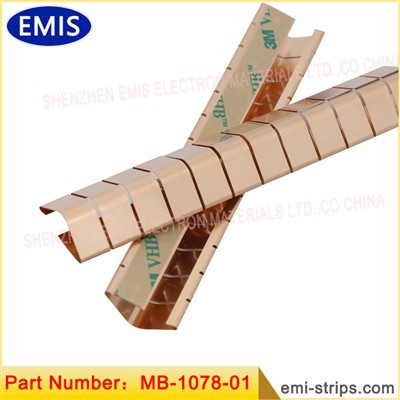

As an RF fingerstock supplier, I've received numerous inquiries about the impedance of RF fingerstock. Understanding impedance is crucial in the world of RF (Radio Frequency) applications, as it directly impacts the performance of electronic devices and systems. In this blog post, I'll delve into what the impedance of RF fingerstock is, why it matters, and how it affects your RF applications.
What is Impedance?
Before we dive into the impedance of RF fingerstock, let's first understand what impedance is. In electrical engineering, impedance is a measure of the opposition that a circuit presents to a current when a voltage is applied. It is a complex quantity, consisting of both resistance (the real part) and reactance (the imaginary part). Resistance is the property that opposes the flow of direct current, while reactance is the property that opposes the change in current due to inductance or capacitance.
The unit of impedance is the ohm (Ω), just like resistance. Impedance is denoted by the symbol Z and can be represented mathematically as Z = R + jX, where R is the resistance, X is the reactance, and j is the imaginary unit (√-1).
Impedance in RF Fingerstock
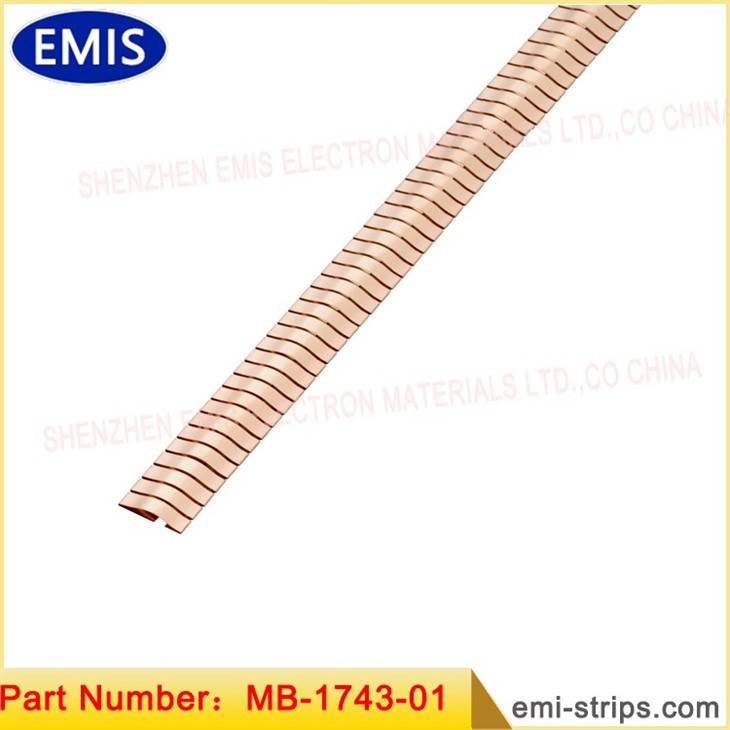
RF fingerstock is a type of conductive gasket used in RF shielding applications. It consists of a series of fingers made of a conductive material, such as beryllium copper (BeCu), that provide a flexible and reliable electrical connection between two surfaces. The impedance of RF fingerstock plays a vital role in determining its effectiveness in RF shielding.
The impedance of RF fingerstock is influenced by several factors, including the material properties of the fingers, the geometry of the fingerstock, and the operating frequency. Let's take a closer look at each of these factors:
Material Properties
The material used to make the fingers of the RF fingerstock has a significant impact on its impedance. Conductive materials with low resistivity, such as BeCu, are commonly used because they offer good electrical conductivity. The conductivity of the material affects the resistance component of the impedance. A higher conductivity results in a lower resistance, which in turn reduces the overall impedance of the fingerstock.
Geometry
The geometry of the RF fingerstock also affects its impedance. The length, width, and thickness of the fingers, as well as the spacing between them, can all influence the impedance. For example, longer fingers tend to have higher inductance, which increases the reactance component of the impedance. On the other hand, wider fingers can reduce the resistance by providing a larger cross-sectional area for current flow.

Operating Frequency
The impedance of RF fingerstock is frequency-dependent. At low frequencies, the resistance component dominates the impedance, while at high frequencies, the reactance component becomes more significant. This is because the inductance and capacitance of the fingerstock have a greater effect on the impedance at higher frequencies. As the frequency increases, the impedance of the fingerstock may change, which can impact its performance in RF shielding applications.
Why Does Impedance Matter in RF Fingerstock?
The impedance of RF fingerstock is important for several reasons:
RF Shielding Effectiveness
The impedance of the fingerstock affects its ability to provide effective RF shielding. When the impedance of the fingerstock is matched to the impedance of the surrounding circuit or system, it minimizes reflections and maximizes the absorption of RF energy. This results in better shielding performance and reduces the leakage of RF signals.
Signal Integrity
In applications where RF signals are transmitted or received, the impedance of the fingerstock can impact signal integrity. A mismatch in impedance can cause signal reflections, which can lead to distortion, attenuation, and other signal quality issues. By using RF fingerstock with the appropriate impedance, you can ensure that the signals are transmitted and received accurately.
EMC Compliance
Electromagnetic compatibility (EMC) is a critical consideration in many electronic devices and systems. RF fingerstock is often used to meet EMC requirements by providing effective RF shielding. The impedance of the fingerstock plays a role in achieving EMC compliance by reducing the emission and susceptibility of RF interference.
Measuring the Impedance of RF Fingerstock
Measuring the impedance of RF fingerstock can be challenging due to its complex geometry and frequency-dependent behavior. However, there are several methods that can be used to measure the impedance, including:
Network Analyzer
A network analyzer is a commonly used instrument for measuring the impedance of RF components. It can measure the scattering parameters (S-parameters) of the fingerstock, which can be used to calculate the impedance. The network analyzer applies a known RF signal to the fingerstock and measures the reflected and transmitted signals. By analyzing the S-parameters, the impedance of the fingerstock can be determined.
Time Domain Reflectometry (TDR)
TDR is another method for measuring the impedance of RF fingerstock. It involves sending a fast electrical pulse along a transmission line and measuring the reflected pulse. The time delay and amplitude of the reflected pulse can be used to calculate the impedance of the fingerstock. TDR is particularly useful for measuring the impedance of long transmission lines and can provide information about the impedance profile along the length of the fingerstock.
Selecting the Right RF Fingerstock Based on Impedance
When selecting RF fingerstock for your application, it's important to consider the impedance requirements. Here are some tips to help you choose the right fingerstock:
Match the Impedance
To ensure optimal performance, it's important to match the impedance of the fingerstock to the impedance of the surrounding circuit or system. This can help minimize reflections and maximize the absorption of RF energy. You can consult with an RF engineer or the manufacturer of the fingerstock to determine the appropriate impedance for your application.
Consider the Operating Frequency
The impedance of RF fingerstock is frequency-dependent, so it's important to consider the operating frequency of your application. Different fingerstock designs may have different impedance characteristics at different frequencies. Make sure to choose a fingerstock that is suitable for the frequency range of your application.
Evaluate the Material and Geometry
The material and geometry of the fingerstock can also affect its impedance. Consider the conductivity of the material, the length and width of the fingers, and the spacing between them. These factors can influence the resistance and reactance components of the impedance. Choose a fingerstock with the appropriate material and geometry to meet your impedance requirements.
Our RF Fingerstock Products
As an RF fingerstock supplier, we offer a wide range of products to meet the diverse needs of our customers. Our products include Solid Top Symmetrical Slotted BeCu Strips 0097095802, ESD Grounding Finger Stock Gaskets 0097004302, and Twisted Finger Gaskets 0097055802. These products are designed to provide excellent RF shielding performance and are available in different sizes and configurations to suit various applications.
Contact Us for Procurement
If you're interested in learning more about our RF fingerstock products or have specific impedance requirements for your application, we'd love to hear from you. Our team of experts can provide you with detailed information and help you select the right fingerstock for your needs. Contact us today to start a procurement discussion and take your RF shielding applications to the next level.
References
- "RF and Microwave Circuit Design for Wireless Applications" by Joseph F. White
- "Electromagnetic Compatibility Engineering" by Henry W. Ott
- "RF Shielding Handbook" by William T. Barry