


When it comes to the world of electronic components and shielding solutions, fingerstock plays a crucial role. As a leading fingerstock supplier, I've had the privilege of witnessing firsthand the diverse applications and the importance of understanding its various properties. One such property that often comes under scrutiny is the thermal conductivity of fingerstock.
Understanding Fingerstock
Before delving into thermal conductivity, let's briefly understand what fingerstock is. Fingerstock is a type of electromagnetic interference (EMI) shielding material. It consists of a series of thin, flexible fingers that are typically made from materials like beryllium copper, phosphor bronze, or stainless steel. These fingers are designed to provide a conductive path between two surfaces, effectively blocking the transmission of electromagnetic waves. This makes fingerstock an essential component in a wide range of electronic devices, from consumer electronics to military and aerospace applications.
The Concept of Thermal Conductivity
Thermal conductivity is a measure of a material's ability to conduct heat. It is defined as the quantity of heat (in watts) transmitted through a unit thickness (in meters) of a material in a direction normal to a surface of unit area (in square meters) due to a unit temperature gradient (in kelvin per meter). In simpler terms, it tells us how well a material can transfer heat from one point to another.
For fingerstock, thermal conductivity is an important property because in many electronic applications, heat management is just as crucial as EMI shielding. Electronic components generate heat during operation, and if this heat is not dissipated effectively, it can lead to reduced performance, shortened lifespan, and even failure of the device. Therefore, understanding the thermal conductivity of fingerstock can help in designing more efficient and reliable electronic systems.
Factors Affecting the Thermal Conductivity of Fingerstock
Several factors can influence the thermal conductivity of fingerstock. The most significant factor is the material from which it is made. Different metals have different thermal conductivities. For example, beryllium copper, which is a popular choice for fingerstock due to its excellent electrical conductivity and spring properties, also has relatively high thermal conductivity. Beryllium copper has a thermal conductivity of around 100 - 200 W/(m·K), depending on its composition and heat treatment.

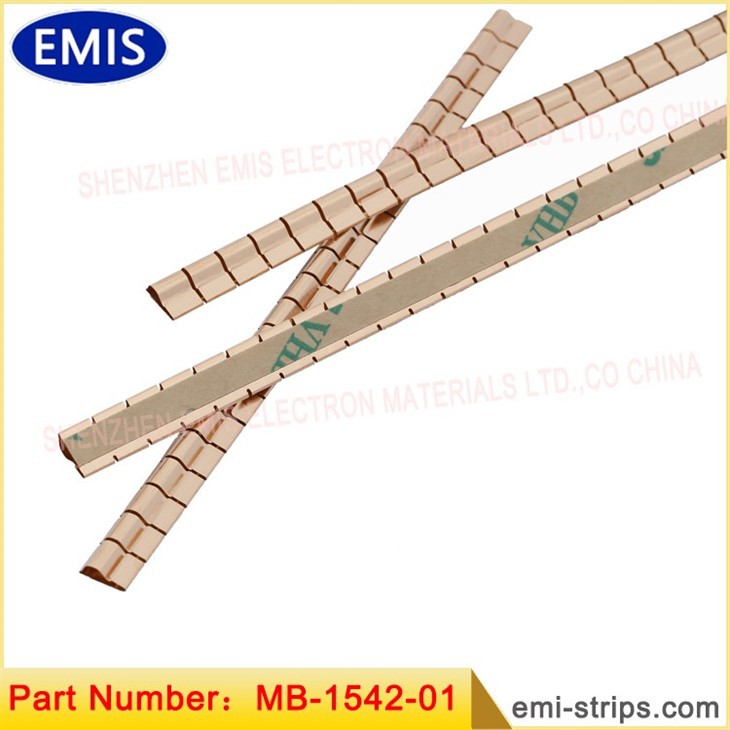
Phosphor bronze, another common material for fingerstock, has a lower thermal conductivity compared to beryllium copper. Its thermal conductivity typically ranges from 20 - 50 W/(m·K). Stainless steel, on the other hand, has a much lower thermal conductivity, usually in the range of 10 - 20 W/(m·K).
The geometry of the fingerstock also plays a role in its thermal conductivity. The thickness, width, and spacing of the fingers can affect how heat is transferred through the material. Thicker fingers generally have higher thermal conductivity because they provide a larger cross - sectional area for heat transfer. However, increasing the thickness may also reduce the flexibility of the fingerstock, which could be a drawback in some applications.
The surface finish of the fingerstock can also impact its thermal conductivity. A smooth surface finish can improve heat transfer by reducing the contact resistance between the fingerstock and the mating surface. On the other hand, a rough or oxidized surface can increase the contact resistance and reduce the overall thermal conductivity.
Importance of Thermal Conductivity in Different Applications
In high - power electronic devices such as power amplifiers, servers, and industrial control systems, heat dissipation is a major concern. Fingerstock with high thermal conductivity can help in transferring the heat generated by these components to a heat sink or other cooling devices. This not only helps in maintaining the optimal operating temperature of the components but also improves the overall efficiency of the system.
In military and aerospace applications, where reliability is of utmost importance, fingerstock with good thermal conductivity can ensure that the electronic systems continue to function properly under extreme conditions. For example, in avionics systems, where the temperature can vary widely during flight, effective heat management is crucial to prevent component failure.
Our Product Range and Thermal Conductivity
As a fingerstock supplier, we offer a wide range of products to meet the diverse needs of our customers. Our EMI Shielding Fingerstrips 0097055502 are made from high - quality beryllium copper, which provides excellent thermal conductivity along with superior EMI shielding performance. These fingerstrips are designed to be flexible and durable, making them suitable for a variety of applications.
Our Twisted Fingerstrips for EMI Shielding 0097055102 are another popular product. They are available in different materials, including phosphor bronze and beryllium copper. Depending on the material chosen, these fingerstrips can offer a range of thermal conductivities to suit different heat management requirements.
Our Standard EMI Strips 0097054202 are designed for general - purpose EMI shielding applications. They are made from a variety of materials, and we can provide detailed information on their thermal conductivity based on the specific material and design requirements of our customers.
Measuring the Thermal Conductivity of Fingerstock
Measuring the thermal conductivity of fingerstock can be a challenging task due to its complex geometry and the fact that it is often used in contact with other materials. One common method is the steady - state method, where a known amount of heat is applied to one end of the fingerstock, and the temperature difference between the two ends is measured. By knowing the dimensions of the fingerstock and the heat input, the thermal conductivity can be calculated using Fourier's law of heat conduction.
Another method is the transient method, which measures the time - dependent temperature response of the fingerstock when a heat pulse is applied. This method is often faster and more suitable for measuring the thermal conductivity of small samples.
Applications and Case Studies
Let's take a look at some real - world applications where the thermal conductivity of fingerstock has played a crucial role. In a data center server application, the server racks generate a significant amount of heat. By using fingerstock with high thermal conductivity between the server components and the heat sinks, the heat can be transferred more efficiently, reducing the overall temperature inside the server racks. This not only improves the performance of the servers but also reduces the energy consumption of the cooling systems.
In a military communication device, where the device needs to operate in harsh environments, fingerstock with good thermal conductivity helps in maintaining the stability of the electronic circuits. The heat generated by the high - power transmitters and receivers can be effectively dissipated, ensuring that the device continues to function properly even under extreme temperature conditions.
Conclusion
In conclusion, the thermal conductivity of fingerstock is an important property that should not be overlooked. It plays a crucial role in heat management in electronic applications, along with its primary function of EMI shielding. As a fingerstock supplier, we understand the importance of providing our customers with products that offer the right balance of thermal conductivity and EMI shielding performance.
If you are looking for high - quality fingerstock products for your electronic applications, we are here to help. Whether you need fingerstock with high thermal conductivity for heat management or excellent EMI shielding for electromagnetic compatibility, we can provide you with the right solutions. Contact us today to discuss your requirements and start a procurement negotiation. We are committed to providing you with the best products and services to meet your needs.
References
- Incropera, F. P., & DeWitt, D. P. (2002). Fundamentals of Heat and Mass Transfer. John Wiley & Sons.
- Holman, J. P. (2010). Heat Transfer. McGraw - Hill.
- ASM Handbook Volume 2: Properties and Selection: Nonferrous Alloys and Special - Purpose Materials. ASM International.


