


How does the end type of EMI Conductive Spring affect its performance?
As a supplier of EMI Conductive Springs, I've witnessed firsthand how the end type of these springs can significantly impact their performance. EMI (Electromagnetic Interference) Conductive Springs are crucial components in various electronic devices, used to prevent electromagnetic interference and ensure the proper functioning of sensitive equipment. In this blog, I'll delve into the different end types of EMI Conductive Springs and how they affect the overall performance.
Understanding EMI Conductive Springs
EMI Conductive Springs are designed to provide a low - resistance path for electrical currents, thereby shielding electronic devices from external electromagnetic fields and preventing the leakage of internal electromagnetic signals. They are commonly made from materials such as beryllium copper (BeCu), which offers excellent electrical conductivity, corrosion resistance, and mechanical properties.
The performance of EMI Conductive Springs is evaluated based on several factors, including electrical conductivity, shielding effectiveness, compression force, and durability. The end type of the spring plays a vital role in determining how well the spring can meet these performance criteria.
Common End Types of EMI Conductive Springs
- Straight Ends
Straight - ended EMI Conductive Springs are the simplest and most common type. They have a straightforward design where the ends of the spring are cut straight. This type of end is easy to manufacture, which makes it cost - effective.
In terms of performance, straight - ended springs offer relatively consistent electrical conductivity along the length of the spring. However, they may not provide the best contact in all situations. When installed in a housing or between two mating surfaces, the straight ends may not conform as well to irregularities in the surface, which can lead to gaps. These gaps can reduce the shielding effectiveness of the spring, as electromagnetic waves can leak through them.

- Rounded Ends
Rounded - ended EMI Conductive Springs have ends that are formed into a rounded shape. This design offers several advantages over straight - ended springs. The rounded ends can better conform to the mating surfaces, even if they are slightly irregular. This improved contact results in a more reliable electrical connection and higher shielding effectiveness.
Rounded ends also distribute the compression force more evenly across the contact area. This is beneficial as it reduces the risk of damage to the spring or the mating surfaces due to concentrated stress. Additionally, the smooth rounded shape reduces the likelihood of snagging or catching on other components during installation, which can improve the overall installation efficiency.
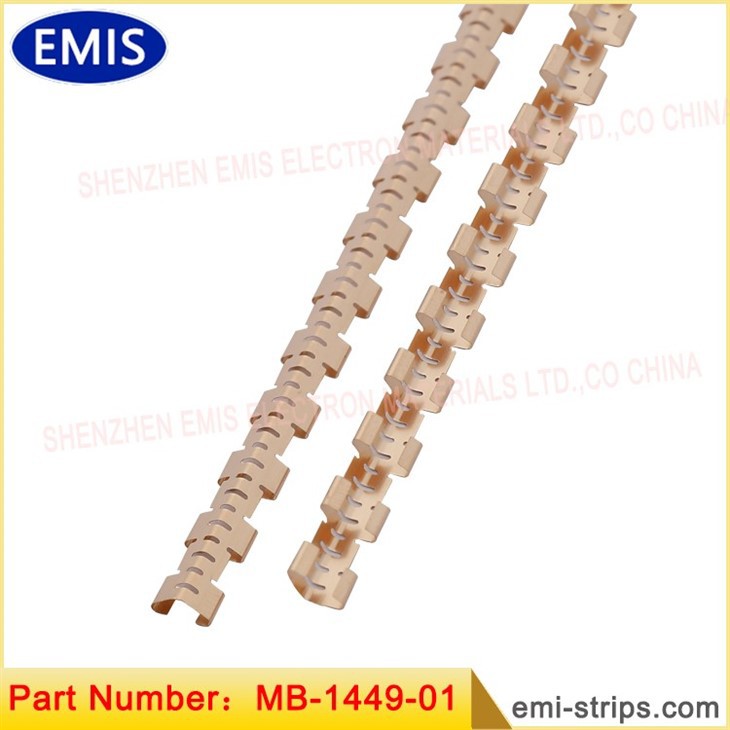
- Hooked Ends
Hooked - ended EMI Conductive Springs have ends that are bent into a hook shape. These springs are often used in applications where a secure attachment is required. The hooks can be used to fasten the spring to a specific location, such as a panel or a chassis.
In terms of performance, hooked - ended springs provide excellent retention. They are less likely to come loose during vibration or movement, which is crucial in applications where stability is essential. However, the hooked ends may have a slightly different electrical conductivity pattern compared to straight or rounded ends. The sharp bends in the hooks can introduce some resistance, but this can be minimized through proper design and material selection.
- Tapered Ends
Tapered - ended EMI Conductive Springs have ends that gradually decrease in width or thickness. This design allows the spring to fit more easily into tight spaces or to provide a more gradual transition of compression force.
Tapered ends can improve the shielding effectiveness in applications where the spring needs to be inserted into a narrow gap. The tapered shape helps to ensure a good seal and reduces the chances of electromagnetic leakage. Additionally, the gradual reduction in size at the ends can make the spring more flexible and less likely to break under stress.
Impact of End Types on Performance Metrics
-
Electrical Conductivity
The end type can have a direct impact on the electrical conductivity of the EMI Conductive Spring. As mentioned earlier, straight - ended springs generally offer consistent conductivity but may have issues with contact. Rounded and tapered ends, on the other hand, can improve the contact between the spring and the mating surfaces, which leads to better electrical conductivity. Hooked ends may introduce some resistance due to the sharp bends, but with proper design, this can be managed. -
Shielding Effectiveness
Shielding effectiveness is a measure of how well the spring can block electromagnetic interference. Springs with rounded or tapered ends are more likely to provide a better seal and conform to the mating surfaces, resulting in higher shielding effectiveness. Straight - ended springs may have gaps that allow electromagnetic waves to pass through, reducing the shielding performance. Hooked - ended springs can also provide good shielding, especially when they are securely attached and the contact is maintained. -
Compression Force
The end type can influence the compression force characteristics of the spring. Rounded and tapered ends distribute the compression force more evenly, which can prevent over - stressing of the spring or the mating surfaces. Straight - ended springs may concentrate the force at the edges, which can lead to premature wear or damage. Hooked - ended springs, due to their design, can provide a more secure attachment and may have different compression force requirements depending on how they are installed. -
Durability
Durability is an important factor, especially in applications where the spring will be subjected to repeated compression and relaxation cycles. Rounded and tapered ends are less likely to cause damage to the mating surfaces or the spring itself due to their smooth and gradual shapes. Straight - ended springs may have sharp edges that can cause abrasion over time. Hooked - ended springs need to be designed properly to ensure that the hooks do not break or deform under stress.
Applications and End Type Selection
The choice of end type depends on the specific application requirements. For example, in applications where cost - effectiveness is a priority and the mating surfaces are relatively smooth, straight - ended springs may be sufficient. However, in high - performance applications where shielding effectiveness and reliability are crucial, rounded or tapered ends may be a better choice.

If the spring needs to be securely attached to a component, hooked - ended springs are ideal. For example, in aerospace or automotive applications where vibration and movement are common, hooked - ended springs can ensure that the spring remains in place and provides consistent shielding.

Conclusion
In conclusion, the end type of EMI Conductive Springs has a profound impact on their performance. As a supplier, we understand the importance of selecting the right end type for each application. Whether you need a simple straight - ended spring for a cost - effective solution or a more specialized rounded, hooked, or tapered - ended spring for high - performance requirements, we can provide the best option for your needs.
If you are in the market for EMI Conductive Springs or related products such as EMI Shielding Gaskets, Low Profile and Grounding BeCu Gasket, or Clip - On BeCu Finger Stock 0097061302, we encourage you to contact us for a detailed discussion about your requirements. Our team of experts is ready to assist you in selecting the most suitable EMI Conductive Spring end type and product for your specific application. We look forward to the opportunity to work with you and help you achieve optimal electromagnetic shielding performance.
References
- "Electromagnetic Interference Shielding Materials and Their Applications" - A comprehensive guide on EMI shielding materials and their performance factors.
- "Mechanical Design of Conductive Springs for EMI Shielding" - Research on the design aspects of conductive springs and how different end types affect their performance.
- Industry standards and specifications related to EMI Conductive Springs and shielding gaskets.


