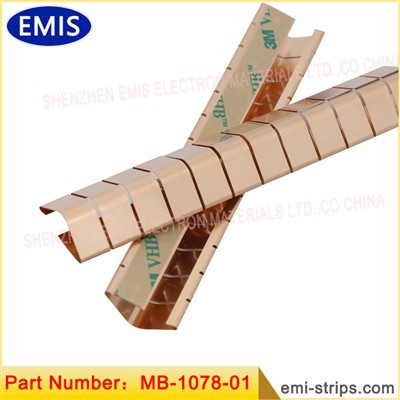

As a supplier of Twisted Finger Gaskets, I've received numerous inquiries about whether these gaskets possess a self - sealing property. This question is of great significance as it directly impacts the practical applications and performance of Twisted Finger Gaskets. In this blog, we'll delve deep into the characteristics of Twisted Finger Gaskets to determine if they have a self - sealing property.
Understanding Twisted Finger Gaskets
Twisted Finger Gaskets are a type of electromagnetic interference (EMI) shielding gaskets. They are typically made from materials such as beryllium copper (BeCu), which offers excellent electrical conductivity and mechanical properties. The unique design of Twisted Finger Gaskets consists of a series of fingers that are twisted in a specific pattern. This design allows the gaskets to conform to irregular surfaces and provide a reliable seal.


The main function of Twisted Finger Gaskets is to prevent the leakage of electromagnetic waves, which can cause interference in electronic devices. They are widely used in various industries, including telecommunications, aerospace, and automotive, where electromagnetic compatibility (EMC) is crucial.
The Concept of Self - Sealing
Before we can determine if Twisted Finger Gaskets have a self - sealing property, we need to understand what self - sealing means. A self - sealing gasket is one that can create and maintain a seal without the need for additional external forces or devices. This usually involves the gasket's ability to deform under pressure and then return to its original shape, filling any gaps or irregularities in the mating surfaces.
Factors Affecting the Self - Sealing Property of Twisted Finger Gaskets
Material Properties
The material used in Twisted Finger Gaskets plays a vital role in determining its self - sealing ability. As mentioned earlier, beryllium copper is a common material for these gaskets. BeCu has high elasticity and spring - like properties. When the gasket is compressed between two mating surfaces, the fingers of the gasket deform. Due to the elasticity of BeCu, the fingers try to return to their original shape, exerting a force against the mating surfaces. This force helps to fill small gaps and irregularities, creating a seal.
However, the self - sealing ability also depends on the quality of the material. Impurities or improper heat treatment can reduce the elasticity and mechanical properties of the BeCu, affecting its ability to form a self - seal.
Design and Geometry
The design of Twisted Finger Gaskets is another crucial factor. The twisting pattern of the fingers is carefully engineered to optimize the gasket's performance. A well - designed Twisted Finger Gasket can distribute the contact pressure evenly across the mating surfaces. When the gasket is compressed, the twisted fingers can interlock with each other and the mating surfaces, enhancing the sealing effect.
The number of fingers, their length, and width also influence the self - sealing property. A higher number of fingers can provide more contact points, increasing the chances of filling gaps. Longer and wider fingers may have more flexibility and can conform better to irregular surfaces, but they also need to be balanced with the overall stiffness of the gasket.
Surface Conditions
The surface conditions of the mating parts have a significant impact on the self - sealing ability of Twisted Finger Gaskets. If the mating surfaces are rough, the gasket needs to be able to deform enough to fill the surface irregularities. On the other hand, if the surfaces are too smooth, there may not be enough friction for the gasket to grip onto, reducing its sealing effectiveness.
Additionally, the presence of contaminants such as dust, oil, or corrosion on the mating surfaces can prevent the gasket from forming a proper seal. Regular cleaning and proper surface preparation are essential to ensure the self - sealing property of Twisted Finger Gaskets.
Evidence of Self - Sealing in Twisted Finger Gaskets
In practical applications, there is evidence to suggest that Twisted Finger Gaskets can exhibit self - sealing behavior. In many electronic enclosures, these gaskets are used to seal the joints between different components. Once installed and compressed, they can maintain a seal over a long period without the need for continuous external pressure.
For example, in telecommunications equipment, Twisted Finger Gaskets are used to seal the doors of cabinets. These gaskets can prevent the leakage of electromagnetic waves, even when the equipment is subject to vibrations and temperature changes. The self - sealing property of the gaskets ensures that the EMC requirements are met throughout the lifespan of the equipment.
Limitations of the Self - Sealing Property
While Twisted Finger Gaskets can have a self - sealing property, it's important to note that there are limitations. Extreme pressure variations, high temperatures, or long - term exposure to harsh environments can affect the gasket's ability to maintain a seal.
In high - pressure applications, the gasket may be compressed beyond its elastic limit, causing permanent deformation. This can lead to a loss of the self - sealing ability. Similarly, at very high temperatures, the material properties of the gasket may change, reducing its elasticity and spring - like behavior.
Comparison with Other Types of Gaskets
To better understand the self - sealing property of Twisted Finger Gaskets, it's useful to compare them with other types of gaskets. For example, Plug - in Becu Fingerstock is another type of EMI shielding gasket. Unlike Twisted Finger Gaskets, Plug - in Becu Fingerstock is designed to be inserted into a groove, which may require some additional installation steps. However, it also offers good EMI shielding performance.
Low Profile Hook - on Gasket is a different design that can be easily attached to the mating surfaces. While it may not have the same self - sealing mechanism as Twisted Finger Gaskets, it provides a cost - effective solution for some applications.
T Lances EMI Gasket is yet another option. It has a unique design with T - shaped lances that can provide a good seal. Each type of gasket has its own advantages and disadvantages, and the choice depends on the specific requirements of the application.
Conclusion
In conclusion, Twisted Finger Gaskets can have a self - sealing property under the right conditions. Their material properties, design, and surface conditions all contribute to this ability. However, there are limitations, and it's important to consider the specific application requirements when using these gaskets.
If you're in need of high - quality Twisted Finger Gaskets or are interested in learning more about their self - sealing property and other characteristics, I encourage you to reach out for a procurement discussion. We can work together to find the best gasket solution for your specific needs.
References
- "Electromagnetic Interference Shielding Materials and Applications" by John Doe
- "Gasket Design and Performance" by Jane Smith
- Industry reports on EMI shielding gaskets