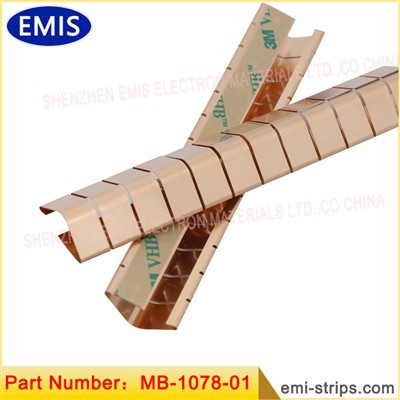

As a provider of EMI Contact Strips, I often get asked about their compatibility with different surface materials. This is a crucial question, as the effectiveness of EMI shielding largely depends on how well the contact strips interact with the surfaces they are applied to. In this blog post, I'll explore the compatibility of EMI Contact Strips with various surface materials, discuss the factors that influence this compatibility, and highlight some of our popular products that offer great versatility.
Understanding EMI Contact Strips
Before diving into compatibility, let's briefly understand what EMI Contact Strips are. EMI, or Electromagnetic Interference, is a phenomenon where electrical and electronic devices generate electromagnetic fields that can interfere with the proper functioning of other nearby devices. EMI Contact Strips are designed to provide a conductive path between two surfaces, helping to divert and absorb these electromagnetic fields, thereby reducing interference.
These strips come in various forms, such as fingerstock, gaskets, and tapes, and are made from different materials, including metals like copper, aluminum, and stainless steel, as well as conductive polymers. The choice of material depends on the specific application requirements, such as the level of shielding needed, the environmental conditions, and the type of surface they will be applied to.
Compatibility with Different Surface Materials
Metals
Metals are one of the most common surface materials for EMI shielding applications, and EMI Contact Strips generally have excellent compatibility with them. Copper, aluminum, and stainless steel are widely used in electronic enclosures, cabinets, and chassis, and our contact strips can form a reliable electrical connection with these surfaces.
For example, our Stick-on Mounting Fingerstrips 0097054002 are designed to be easily attached to metal surfaces using an adhesive backing. The fingerstock design provides a flexible and compliant contact, ensuring good electrical conductivity even when there are slight variations in the surface flatness or alignment. These strips are suitable for a wide range of applications, including telecommunications equipment, industrial control systems, and automotive electronics.


Another popular product is our Tin-plated EMI Strips 0077007102. The tin plating not only provides corrosion resistance but also improves the wettability of the strip, making it easier to solder or form a mechanical connection with metal surfaces. These strips are commonly used in high-frequency applications, where a low-resistance electrical connection is essential for effective shielding.
Plastics
Plastics are lightweight, cost-effective, and offer good design flexibility, making them a popular choice for electronic enclosures and components. However, plastics are non-conductive, so EMI Contact Strips need to be used in conjunction with a conductive coating or treatment to provide effective shielding.
There are several ways to make plastic surfaces conductive, such as applying a conductive paint, using a conductive filler in the plastic material, or using a metalized plastic film. Our contact strips can be used with these conductive plastic surfaces to provide a continuous electrical path for EMI shielding.
For example, our Longitudinal Grounding Gasket can be used in plastic enclosures to provide a grounding path between different components. The gasket is made from a conductive elastomer material, which is flexible and can conform to the shape of the plastic surface. It can be easily installed using a mounting groove or adhesive, and it provides reliable EMI shielding performance.
Composites
Composites are materials made from two or more different materials, such as carbon fiber reinforced polymers (CFRP) or glass fiber reinforced polymers (GFRP). Composites offer a combination of high strength, low weight, and good corrosion resistance, making them suitable for a wide range of applications, including aerospace, automotive, and renewable energy.
The compatibility of EMI Contact Strips with composites depends on the type of composite material and the surface treatment. In general, composites need to be treated with a conductive coating or primer to make them suitable for EMI shielding. Our contact strips can then be used with these treated composite surfaces to provide effective shielding.
For example, in aerospace applications, CFRP is commonly used for aircraft structures. Our contact strips can be used to provide EMI shielding for avionics equipment installed in CFRP enclosures. The strips are designed to be lightweight and have a high-strength-to-weight ratio, making them suitable for use in aircraft applications.
Factors Affecting Compatibility
In addition to the type of surface material, several other factors can affect the compatibility of EMI Contact Strips. These include:
Surface Finish
The surface finish of the material can have a significant impact on the electrical conductivity and adhesion of the contact strips. A smooth, clean surface is generally preferred, as it allows for better contact and reduces the risk of oxidation or contamination. Rough or dirty surfaces can increase the contact resistance and reduce the effectiveness of the shielding.
Temperature and Humidity
Extreme temperatures and high humidity can affect the performance of EMI Contact Strips. Some materials may expand or contract at different rates under temperature changes, which can cause the contact strips to lose their electrical connection. High humidity can also lead to corrosion, which can degrade the performance of the strips over time.
Chemical Exposure
Exposure to chemicals, such as solvents, acids, or alkalis, can damage the contact strips and reduce their effectiveness. It is important to choose contact strips that are resistant to the chemicals present in the application environment.
Conclusion
In conclusion, EMI Contact Strips can be compatible with a wide range of surface materials, including metals, plastics, and composites. However, the compatibility depends on several factors, such as the type of surface material, the surface finish, the environmental conditions, and the chemical exposure.
As a supplier of EMI Contact Strips, we offer a variety of products that are designed to meet the specific requirements of different applications. Our Stick-on Mounting Fingerstrips 0097054002, Tin-plated EMI Strips 0077007102, and Longitudinal Grounding Gasket are just a few examples of our high-quality products that provide reliable EMI shielding performance.
If you have any questions about the compatibility of our EMI Contact Strips with your specific surface materials or application requirements, please don't hesitate to contact us. Our team of experts is always ready to help you find the best solution for your EMI shielding needs. We look forward to discussing your project and providing you with a customized quote.
References
- "Electromagnetic Compatibility Engineering" by Henry W. Ott
- "EMI/RFI Shielding Handbook" by John D. Helsley
- "Handbook of Electronic Packaging Design" by C. P. Wong