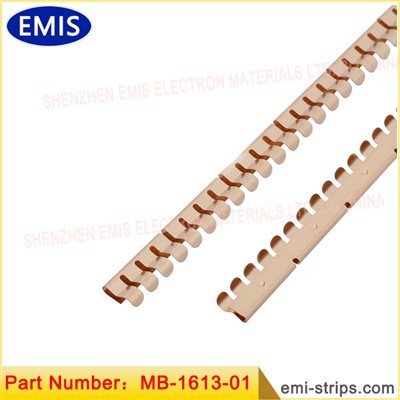

The development of modern electronics has placed an increasing demand on electromagnetic interference (EMI) shielding solutions. Among the various EMI shielding components, the EMI Conductive Spring has emerged as a crucial player. As a proud supplier of EMI Conductive Springs, I am often asked about how different characteristics of these springs affect their performance. In this blog, I'll delve into one specific aspect: how the wire diameter of an EMI Conductive Spring can influence its performance.
Basics of EMI Conductive Springs
Before we dig into the relationship between wire diameter and performance, it's essential to understand what EMI Conductive Springs are. These springs are designed to provide electrical conductivity and mechanical flexibility. They are commonly used in electronic enclosures to prevent EMI from leaking in or out, which is crucial for maintaining the proper functioning of electronic devices and complying with electromagnetic compatibility (EMC) standards.
Impact of Wire Diameter on Electrical Conductivity
One of the most fundamental aspects of EMI Conductive Springs is their electrical conductivity. The wire diameter plays a significant role in determining this property. According to Ohm's law, resistance (R) is inversely proportional to the cross - sectional area (A) of a conductor. The cross - sectional area of a wire is calculated using the formula (A=\pi(d/2)^2), where (d) is the wire diameter. As the wire diameter increases, the cross - sectional area increases, and the resistance of the wire decreases.
A lower resistance means better electrical conductivity. In the context of EMI shielding, better conductivity is highly desirable. When an EMI Conductive Spring has low resistance, it can more effectively conduct the electromagnetic energy induced by EMI, allowing it to be safely dissipated or redirected. For example, in high - frequency applications, where EMI can be particularly problematic, a spring with a larger wire diameter can provide a more efficient path for the high - frequency currents, reducing the amount of EMI that can penetrate the enclosure.
Influence on Mechanical Properties
The wire diameter also has a profound impact on the mechanical properties of EMI Conductive Springs.
Compression and Deflection
The ability of a spring to compress and deflect under load is a critical mechanical characteristic. A spring made with a larger wire diameter is generally stiffer and can withstand higher compression forces. This means that in applications where the spring needs to maintain a certain level of contact pressure even under significant mechanical stress, a larger wire diameter may be preferred.
For instance, in industrial electronic equipment that is subject to vibrations and shocks, a stiffer spring with a larger wire diameter can ensure that the EMI shielding remains intact. On the other hand, a spring with a smaller wire diameter is more flexible and can be easily compressed. This makes it suitable for applications where a lower contact force is required, such as in some consumer electronics where delicate components are involved.
Fatigue Resistance
Fatigue resistance is another important mechanical property. Springs are often subjected to repeated compression and relaxation cycles during their service life. A larger wire diameter can enhance the fatigue resistance of the spring. The thicker wire can better withstand the stress concentrations that occur during these cycles, reducing the likelihood of fatigue failure. In long - term applications where the spring will experience numerous mechanical cycles, a larger wire diameter can increase the reliability and lifespan of the EMI Conductive Spring.
Effect on Shielding Effectiveness
The shielding effectiveness of an EMI Conductive Spring is determined by its ability to attenuate electromagnetic waves. The wire diameter can impact shielding effectiveness in multiple ways.
In general, a spring with a larger wire diameter can provide better shielding at lower frequencies. This is because the larger cross - sectional area of the wire allows for better conduction of the low - frequency electromagnetic energy, which is typically easier to dissipate through the spring.
However, at higher frequencies, the skin effect comes into play. The skin effect causes the current to flow predominantly on the outer surface of the wire. In this case, a very large wire diameter may not necessarily translate to better shielding performance. A well - designed spring with an appropriate wire diameter and pitch can maximize the surface area available for current flow, enhancing the shielding effectiveness at high frequencies.
Selection of Wire Diameter Based on Application
When selecting the wire diameter of an EMI Conductive Spring, it's crucial to consider the specific application requirements.
For aerospace and military applications, where high - reliability and excellent EMI shielding are paramount, larger wire diameters may be preferred. These applications often involve harsh environments, high - intensity EMI sources, and long service lives. For example, in avionic systems, EMI Conductive Springs with larger wire diameters can provide reliable shielding against a wide range of electromagnetic frequencies and withstand the mechanical stresses associated with flight.
In consumer electronics, such as smartphones and tablets, space and flexibility are often more critical. Smaller wire diameters can be used to create thinner and more flexible springs that can fit into tight spaces and provide adequate shielding for the relatively lower - intensity EMI generated by these devices.
Our Product Offerings
As a supplier of EMI Conductive Springs, we offer a wide range of products with different wire diameters to meet various application needs. For example, our Clip-On BeCu Finger Stock 0097061302 is available in multiple wire diameters, allowing you to choose the one that best suits your requirements. Our EMI Copper Finger Gasket also offers a variety of wire diameter options, providing excellent electrical conductivity and shielding performance. And our EMI Shielding Contacts Spring is designed with different wire diameters to ensure optimal performance in different environments.


Contact Us for Procurement
If you are in the market for high - quality EMI Conductive Springs and need assistance in choosing the right wire diameter for your application, we are here to help. Our team of experts can provide you with detailed technical advice and solutions tailored to your specific needs. Feel free to reach out to us for procurement discussions. We are committed to providing you with the best products and services to meet your EMI shielding requirements.
References
- Grover, F. W. (1946). Inductance Calculations: Working Formulas and Tables. Dover Publications.
- Paul, C. R. (2006). Introduction to Electromagnetic Compatibility. Wiley - Interscience.
- Montrose, M. I. (1999). Printed Circuit Board Design Techniques for EMC Compliance: A Handbook for Designers. Wiley - Interscience.